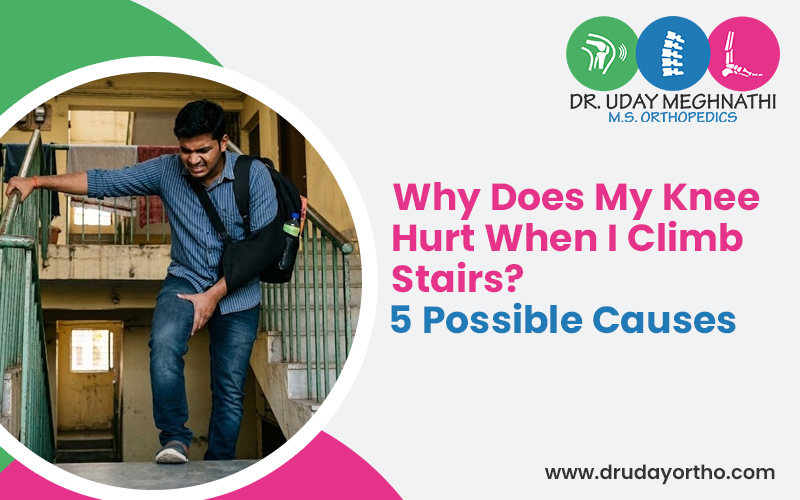
If you’re experiencing knee pain climbing stairs causes, you’re not alone. Many patients visit our clinic complaining that their knees feel fine while walking on flat ground, but hurt sharply while going up or down stairs. Climbing stairs places nearly 3-4 times your body weight on the knee joint. That extra pressure can expose underlying joint problems that may not be noticeable otherwise.
As a leading orthopedic surgeon in Vadodara, Dr. Uday Megnathi regularly evaluates patients with stair-related knee pain. In this article, we’ll explain the most common causes, warning signs, and when you should consult a knee specialist.
That sharp ache you feel halfway up a flight of stairs — but not while walking on flat ground — is not random, and it is not something you should get used to. Knee pain when climbing stairs is one of the most common complaints Dr. Uday Meghnathi hears from patients across all age groups in Vadodara. The reason it happens specifically on stairs is simple: every step upward loads the knee joint with nearly three to four times your body weight. That pressure exposes problems — worn cartilage, a misaligned kneecap, a small meniscus tear — that ordinary walking simply does not stress enough to trigger. So if you are wondering why your knee hurts on stairs but feels fine otherwise, the stairs are not the problem. They are revealing one.
Why Does Stair Climbing Put Pressure on Your Knee?
Your knee joint works like a hinge between the thigh bone (femur) and shin bone (tibia). When climbing stairs:
➤ The knee bends deeper than normal walking
➤ The kneecap (patella) presses firmly against the thigh bone
➤ Muscles and ligaments work harder to stabilize the joint
If cartilage is damaged or alignment is poor, this increased load can trigger pain.
5 Possible Causes for Knee Pain When Climbing Stairs
The most frequent culprit behind front knee pain on stairs is Patellofemoral Pain Syndrome — commonly called runner’s knee — where the kneecap fails to track smoothly over the thigh bone during movement. A closely related condition, chondromalacia patella, involves the softening of cartilage directly beneath the kneecap, and patients with this often notice the pain is actually worse going downstairs than going up.
In older patients, the picture tends to look different: morning knee stiffness that gradually eases, swelling that returns after a long day, and a slow worsening over months usually points toward knee osteoarthritis, where the joint cartilage has thinned over time. A meniscus tear — whether from an old sports injury or simply years of use — is another common source of stair-related pain, often producing a sharp, catching sensation at a specific point in the movement. Each of these conditions responds differently to treatment, which is exactly why self-diagnosing and self-medicating rarely works for long.
1. Patellofemoral Pain Syndrome (Runner’s Knee)
One of the most common knee pain climbing stairs causes is Patellofemoral Pain Syndrome (PFPS). This condition occurs when the kneecap does not move smoothly over the thigh bone, causing irritation.
Symptoms of Patellofemoral Pain Syndrome
➤ Pain in the front of the knee
➤ Discomfort when climbing stairs
➤ Pain after sitting for long periods
➤ Grinding or clicking sensation
PFPS is common in young adults, athletes, and individuals with weak thigh muscles.
2. Knee Osteoarthritis
Knee osteoarthritis is a degenerative joint condition caused by gradual cartilage wear. It is especially common in individuals above 45 years of age.
How Osteoarthritis Makes Stairs Painful
When cartilage thins:
➤ Bones rub against each other
➤ Inflammation develops
➤ Swelling and stiffness increase
Stair climbing becomes painful because the joint surfaces are compressed under higher load. If you have persistent knee stiffness in the morning along with pain while climbing stairs, you may need evaluation by the best orthopedic doctor in Vadodara.
Learn more about treatment options on our Knee Osteoarthritis Treatment Page. & Knee Osteoarthritis Overview
3. Meniscus Tear
The meniscus is a C-shaped cartilage that cushions the knee joint.
A tear can occur due to:
➤ Sudden twisting injury
➤ Sports trauma
➤ Age-related degeneration
Common symptoms include:
➤ Sharp pain while turning or bending
➤ Locking or catching sensation
➤ Swelling after activity
Stair climbing may trigger pain because the torn cartilage gets compressed. If suspected, consult a knee specialist in Vadodara for MRI evaluation.
Read more on our Meniscus Injury Page. & What is a Meniscus Injury
4. Chondromalacia Patella
This condition involves softening or damage of cartilage under the kneecap.
It is common in:
➤ Teenagers
➤ Athletes
➤ Individuals with muscle imbalance
Symptoms include:
➤ Dull aching pain in front of the knee
➤ Pain is worse when going downstairs
➤ Crunching sensation
Early diagnosis prevents long-term cartilage damage.
Warning Signs You Should Never Ignore
While mild discomfort may improve with rest, seek medical attention if you notice:
➤ Swelling that does not reduce
➤ Knee locking or instability
➤ Sudden inability to bear weight
➤ Severe pain after injury
➤ Persistent pain lasting more than 2 weeks
Ignoring symptoms can worsen joint damage.
Warning Signs You Should Never Ignore
While mild discomfort may improve with rest, seek medical attention if you notice:
➤ Swelling that does not reduce
➤ Knee locking or instability
➤ Sudden inability to bear weight
➤ Severe pain after injury
➤ Persistent pain lasting more than 2 weeks
Ignoring symptoms can worsen joint damage.
Treatment Options
Depending on the cause, treatment may include:
➤ Physiotherapy
➤ Anti-inflammatory medication
➤ Knee braces
➤ PRP injections
➤ Knee replacement surgery (in advanced arthritis)
When Should You See an Orthopedic Doctor?
You should consult the best orthopedic doctor in Vadodara if:
➤ Pain interferes with daily activities
➤ Stairs become increasingly difficult
➤ Conservative treatment fails
➤ There is visible swelling or deformity
Early diagnosis prevents long-term joint deterioration. Dr. Uday Meghnathi is a trusted knee specialist in Vadodara known for accurate diagnosis and personalized treatment planning. If you are wondering about knee pain climbing stairs causes, the reason may range from mild cartilage irritation to advanced osteoarthritis. Ignoring knee pain can lead to worsening joint damage and limited mobility. Book Your Consultation with Dr. Uday Meghnathi today.
Treatment depends entirely on the underlying cause — and that is the part most people get wrong by waiting too long. In early stages, the right physiotherapy, anti-inflammatory care, and knowing which knee pain exercises to avoid can make a significant difference without any intervention. PRP injections have shown real results for cartilage-related cases, and where structural damage is confirmed, arthroscopic knee surgery remains one of the most reliable minimally-invasive options available in India today.
The warning signs that tell you it is time to stop managing this at home: knee swelling after activity that does not settle overnight, kneecap pain that has spread or changed in character, or any episode where the knee gives way under you. If your knee pain while climbing stairs has been present for more than two weeks, that is already the answer to when to see a doctor — the time is now. Dr. Uday Meghnathi offers personalised evaluation and a clear diagnosis before any treatment is recommended. Book your consultation today.
Frequently Asked Questions (FAQ)
Why does my knee hurt when climbing stairs but not walking?
Climbing stairs increases pressure on the kneecap and cartilage. Conditions like PFPS or osteoarthritis often cause pain only under higher load.
Can knee pain climbing stairs causes indicate arthritis?
Yes. Knee osteoarthritis is one of the most common causes of stair-related knee pain.
Is knee pain while climbing stairs serious?
It depends on the cause. Persistent pain should always be evaluated by an orthopedic surgeon in Vadodara.
When is knee replacement necessary?
Knee replacement is considered when severe osteoarthritis limits mobility and conservative treatments fail.