
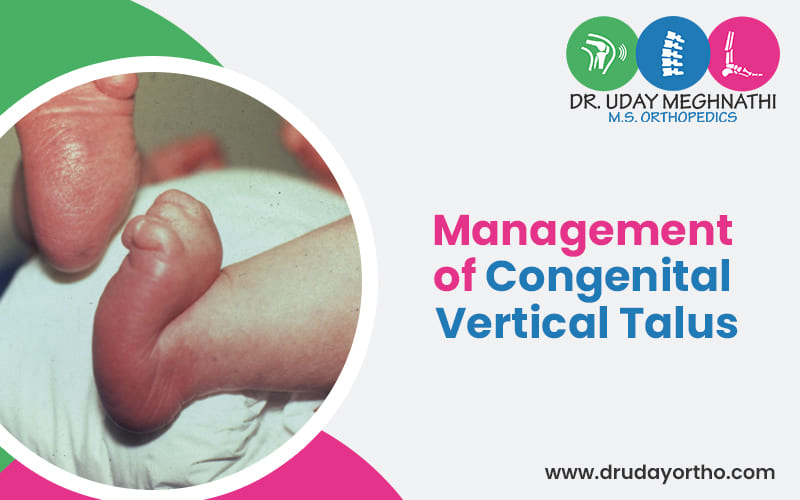
Congenital Vertical Talus is also known as “rocker-bottom feet”. It is a condition where a rigid foot deformity is present at birth, characterized by the talus bone being in a vertical position and the navicular bone being dislocated dorsally. This misalignment gives the foot a rock-bottom look and keeps the heel off the ground.
Most of the parents think that there is no treatment for it; however, there are many treatment options available for it. In this blog, we will at its the cause, management, and treatment options from the best orthopedic doctor in Vadodara, Dr Uday Meghnathi.
Causes of Congenital Vertical Talus
➤ Genetic Factors: This condition is linked to genetic defects, with some cases following autosomal dominant inheritance patterns.
➤ Neuromuscular Disorders: It is often associated with conditions like spina bifida, cerebral palsy, and arthrogryposis.
➤ Chromosomal Abnormalities: It is linked to chromosomal issues such as trisomy 13, 14, and 18.
➤ Developmental Problems: Abnormal development of the foot during pregnancy, muscle imbalances, and intrauterine pressure can also contribute to deformity.
Seek immediate medical assistance in such cases because most of the pediatric orthopedic issues can be resolved at a young age due to soft bones. Dr Uday Meghnathi is an exceptional pediatric orthopedic doctor providing highly successful congenital vertical talus treatment in Vadodara. He holds rich experience in helping infants with deformities. From fractures to clubfoot, he provides world-class treatment for all complex orthopedic issues. To get a consultation, call us.
Characteristics of Congenital Vertical Talus
➤ The middle of the foot is curved outwards and touches the ground while the toes and heel point upward.
➤ It makes the foot entirely rigid and does not allow the foot to be flexible after stretching or bracing.
➤ The foot causes midfoot dorsiflexion and forefoot abduction.
➤ If you do not understand the deformity, visit an experienced pediatric orthopaedic doctor in Vadodara.
Diagnosis of Congenital Vertical Talus
➤ The doctor will initially examine the child’s foot and leg while standing and in motion.
➤ X-ray is also used to diagnose bone deformity.
➤ EOS imaging is an advanced technology that creates a 3-D image when the child is upright.
➤ A CT scan is also used to produce cross-sectional images of the body.
Treatment of Congenital Vertical Talus
➤ Non-Surgical Methods: Stretching exercises for the forefoot and hindfoot.
➤ Non-Invasive Methods: Serial manipulation and casting of the foot to get it into the desired shape and position.
➤ Surgical Method: Surgery for the talus foot is very complicated and must be performed only by an exceptional pediatric orthopaedic surgeon in Vadodara.
Conclusion For CVT
CVT occurs due to genetic defects and leaves a strong impact on a person’s life. Treating a congenital vertical talus is definitely a tough job, but Dr Uday Meghnathi (The Best orthopedic doctor in Baroda)can treat it by surgery or casting seamlessly. Our clinic is fully equipped with all modern treatment technologies and machines to support positive patient outcomes. The treatment must be started as soon as possible to get better results. Call to book an appointment for your child.
Also Check: Clubfoot Vs Disability